
New Generation All-in-One PIU2000D High-Precision DC Tester
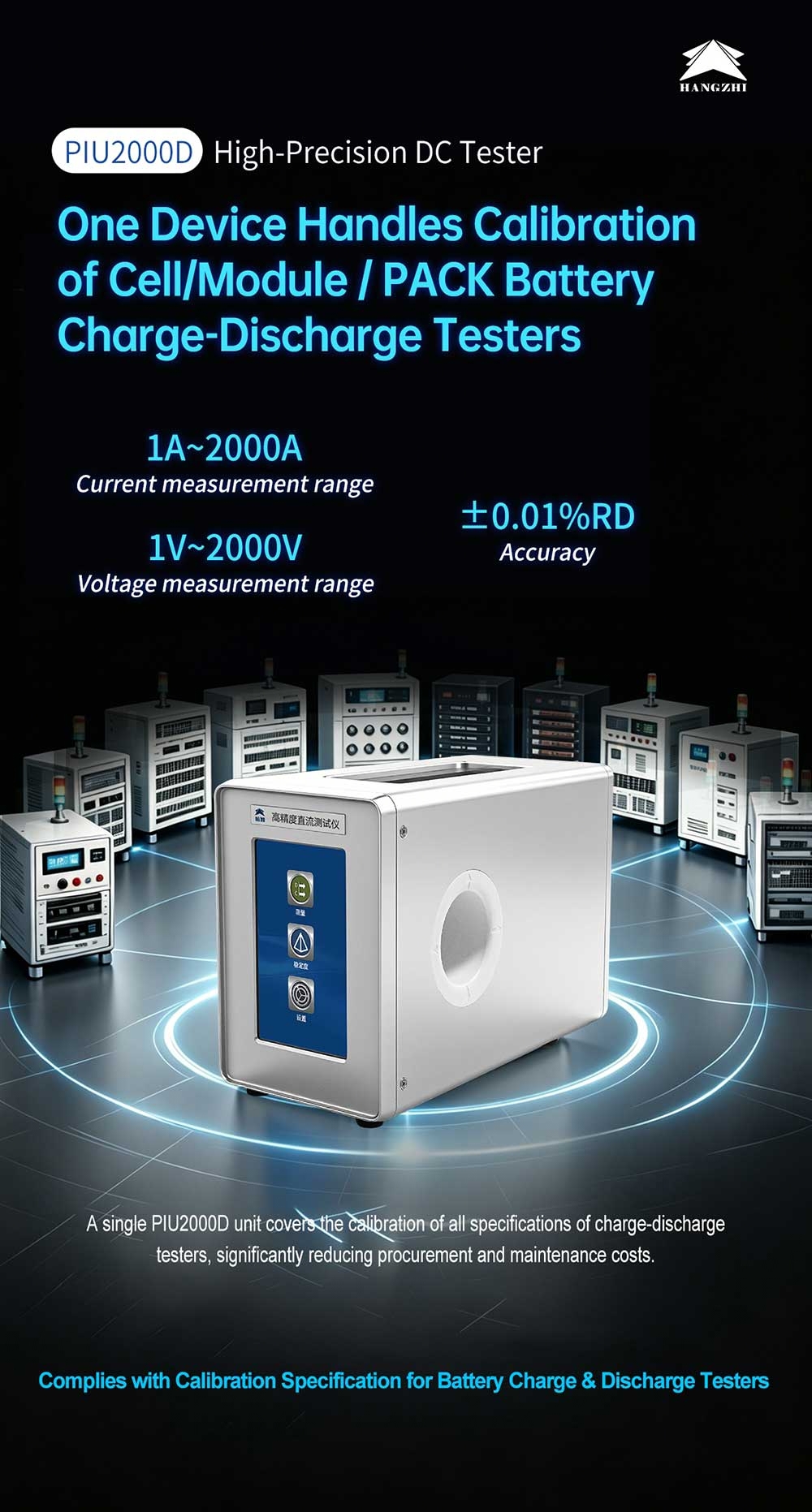
Hangzhi’s New-Generation PIU2000D High-Precision DC Tester: One Unit Handles the Calibration of Cell, Module, and PACK Battery Charge-Discharge Testers.
In battery testing—from single cells to modules and full PACKs—requirements for charge-discharge testers are getting more varied.:
- Common specifications for battery cell charge-discharge testers: 5V / 5A–1000A (±0.05% FS)
- Common specifications for battery module charge-discharge testers: 60V–200V / 10A–200A (±0.01% FS)
- Common specifications for battery pack (PACK) charge-discharge testers: 600kW/800V / 600kW/1650V (±0.03% FS)
However, existing calibration methods for battery charge-discharge testers remain stuck in a traditional phase characterized by the “stacking of discrete equipment,” facing the following critical pain points:
- Equipment Redundancy: Reliance on a combination of shunts, multimeters, and multi-range standard meters results in complex wiring, manual data conversion, and low operational efficiency.
- Precision Imbalance: While many high-precision testers demonstrate excellent accuracy in the high-current range (above 200A), they often utilize “range accuracy” (% RG) rather than “reading accuracy” (% RD) in the low-current range (1A–200A), leading to significantly larger measurement errors for small signals.
- High-Voltage Blind Spots: The voltage measurement ceiling for traditional multimeters is typically limited to 1000V, rendering them incapable of handling the calibration requirements for energy storage systems and battery packs operating above this threshold.
Traditional solutions are no longer adequate to meet the calibration demands of the new generation of battery charge-discharge testing instruments.
Hangzhi’s newly upgraded PIU2000D high-precision DC tester was designed specifically to solve these calibration challenges!
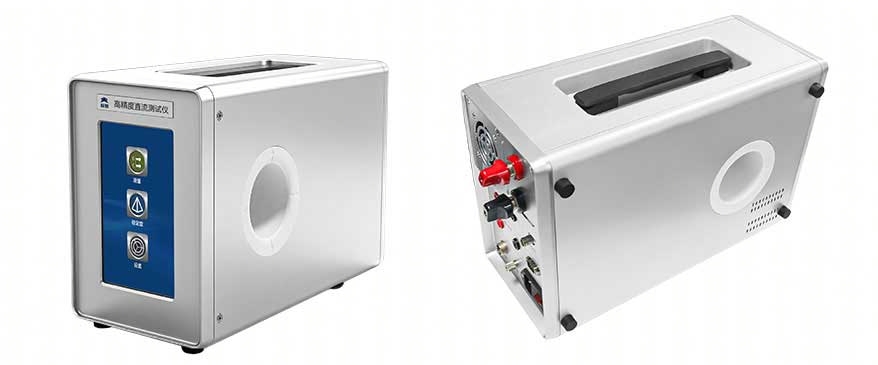
PIU2000D Four Core Technological Advantages: Defining New Heights in Precision Calibration
1. Uniform 0.01% Reading Accuracy Across Full Current and Voltage Ranges
Unlike most products that have higher error in the low range (1A–200A) due to %RG design, the PIU2000D delivers ±0.01% reading accuracy across the full range—1A to 2000A for current and 1V to 2000V for voltage. This ensures equally reliable testing for both low-current and high-voltage scenarios, allowing a single unit to handle the calibration of battery cell, module, and PACK charge-discharge testers.
2. Dual-Mode: Feed-Through and Direct-Input
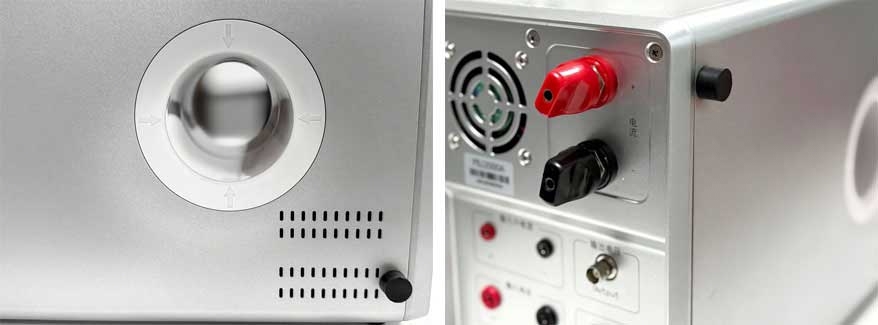
Features a high-current feed-through mode (with a large 70 mm aperture) that employs isolated measurement for high currents, alongside a direct-input mode for low currents that guarantees the accuracy of weak signals. This multi-purpose functionality reduces the user’s initial investment costs.
3. Integrated Voltage, Current, and Power Measurement
Simultaneously measures voltage, current, and power—a capability superior to pure ammeter-based solutions. It also resolves the challenge faced by standard multimeters regarding the measurement of voltages exceeding 1000V, thereby satisfying a diverse range of testing requirements.
4. Multiple Communication Interfaces for Rapid Calibration Efficiency
Comes standard with RS232 and RS485 interfaces, with an optional CAN interface available. This allows calibration results to be directly imported into test reports, exponentially boosting work efficiency and facilitating seamless system integration and automated testing.
PIU2000D Four Key Application Solutions: Reshaping Testing Efficiency
1. One Device Covers All Specifications: Significantly Reduced Costs
Industry Status Quo: Third-party testing agencies and manufacturers often deal with a wide variety of equipment specifications and models requiring testing. Different specifications of charge-discharge testers typically require matching with various calibration devices, resulting in substantial hardware asset investments and high management costs.
Hangzhi Solution: Multi-purpose functionality in a single unit. The PIU2000D covers a current range of 1A to 2000A and a voltage range of 1V to 2000V, maintaining a full-scale reading accuracy of ±0.01%. A single device is compatible with the calibration of virtually all charge-discharge tester specifications, significantly reducing procurement and maintenance costs.
2. Consistent ±0.01% Reading Accuracy Across the Full Range: Precision Even at Low Currents
Industry Status Quo: Traditional equipment performs adequately in the high-current range; however, in the low-current range (1A–200A), they often rely on “range accuracy” (%RG) specifications. This leads to larger error margins and fails to meet the high-precision requirements for battery cell charge-discharge testers.
Hangzhi Solution: The PIU2000D maintains a reading accuracy of ±0.01% across its entire operating range. Whether measuring 1A or 2000A, the precision remains consistent, ensuring reliable multi-purpose utility from a single device.
3. Breaking Through the Bottleneck of High-Voltage Testing (>1000V)
Industry Status Quo: Traditional multimeters are limited to measuring voltages up to 1000V. However, modern energy storage battery testing often involves voltages approaching 2000V; consequently, traditional multimeters are no longer capable of meeting these new testing demands.
Hangzhi Solution: The PIU2000D offers a full-scale voltage range of 1V to 2000V with a reading accuracy of ±0.01%. It effectively meets the high-voltage testing requirements for energy storage batteries, providing a practical solution to a critical industry pain point.
4. Integrated Design for Simplified Operation: Enhanced Efficiency and Stability
Industry Status Quo: The traditional “shunt + multimeter” configuration offers a precision level of only 0.1 to 0.5. Furthermore, it requires manual data conversion, is prone to errors introduced by contact resistance in wiring, and suffers from stability issues caused by temperature drift—all of which result in low operational efficiency.
Hangzhi Solution: PIU2000D. Features 0.01-grade direct-reading accuracy, eliminating the need for external shunts or cumbersome calculations while effectively nullifying the influence of wiring resistance. It supports both cable-through and series connection methods and offers multiple communication interfaces—with RS232 and RS485 included as standard, and a CAN interface available as an option. Calibration results can be directly imported into test reports, thereby exponentially boosting operational efficiency and facilitating seamless system integration and automated testing.
The PIU2000D is specifically designed for the calibration of current charge-discharge testers.
In the field of battery testing and metrology, the transformative impact of the PIU2000D can be summarized in a single statement:
A single Hangzhi PIU2000D unit handles the calibration of battery charge-discharge testers across all specifications and models.
Beyond simply enhancing data credibility, it delivers:
- A substantial increase in calibration efficiency
- A significant reduction in testing costs
- Comprehensive coverage of both laboratory and field applications
The PIU2000D serves as a pivotal tool for battery manufacturers, metrology institutions, testing laboratories, and similar entities seeking to enhance their competitive edge.
Sobre Hangzhi
Eletrônica Co. da precisão de Shenzhen Hangzhi, Ltd. é uma empresa líder em tecnologia dedicada à investigação e desenvolvimento, produção, vendas e personalização de soluções de sensores de corrente de alta precisão, sensores de tensão e instrumentos de medição eléctrica de alta precisão. Esforçamo-nos por construir uma marca bem conhecida de fluxgate sensores de corrente de precisão e instrumentos de medição eléctrica de precisão no domínio da corrente contínua, e esforçar-se por se tornar um líder internacional em eletrónica de precisão no domínio dos sistemas de corrente contínua.